Gypsum for Agriculture: Boost Soil Moisture & Drought Resistance
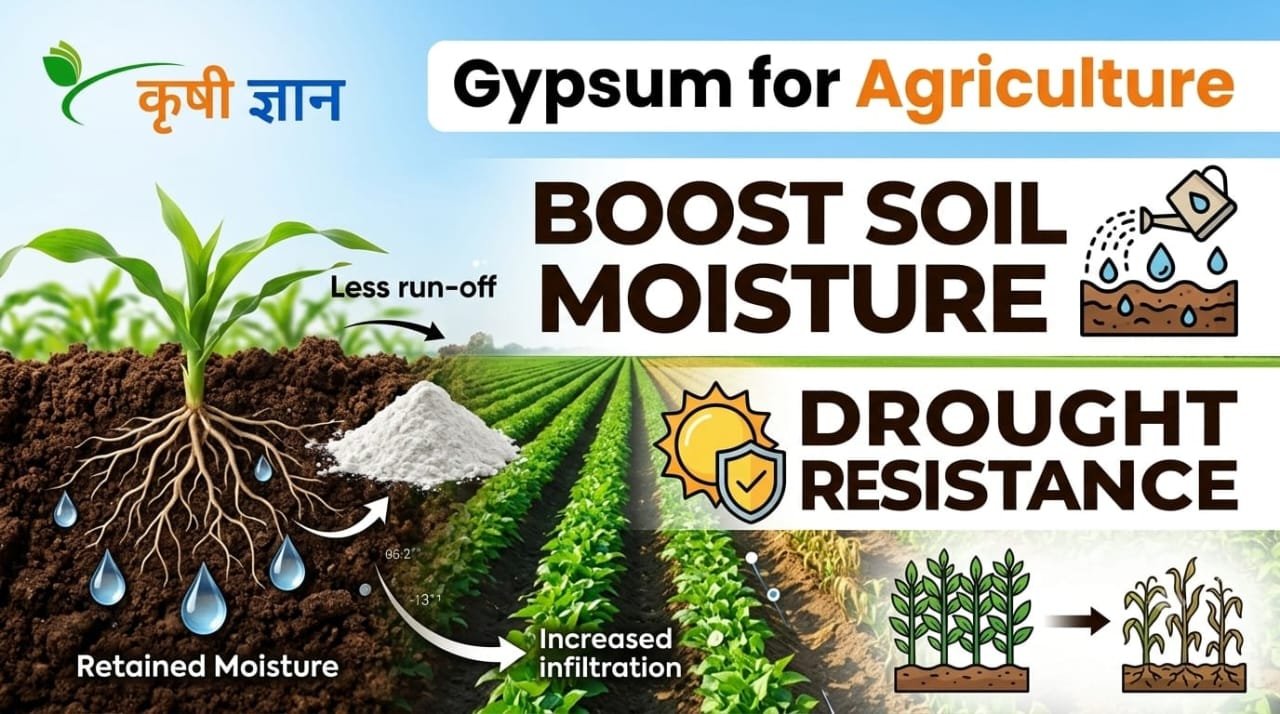
Gypsum for Agriculture: Boost Soil Moisture & Drought Resistance
Gypsum in agriculture is becoming an important soil-management option, especially in drought-prone areas where farmers face long rainfall gaps and declining soil moisture.
Agricultural gypsum is mainly Calcium Sulphate Dihydrate (CaSO₄·2H₂O) and provides two important nutrients: Calcium (Ca) and Sulphur (S).
But an important question is: Can gypsum increase soil water holding capacity and help crops during drought?
The answer needs some technical understanding.
How Does Gypsum Work in Soil?
When gypsum dissolves in soil moisture, it releases calcium and sulphate ions:
CaSO₄·2H₂O → Ca²⁺ + SO₄²⁻ + 2H₂O
The calcium ion (Ca²⁺) is particularly important for soil structure.
In sodic or sodium-affected soils, excessive sodium (Na⁺) can cause clay particles to disperse. This may lead to poor soil structure, surface crusting, reduced infiltration and increased runoff.
Gypsum supplies Ca²⁺, which can replace exchangeable sodium:
Soil–Na + Ca²⁺ → Soil–Ca + Na⁺
With sufficient water movement and drainage, the displaced sodium can move below the root zone.
As a result, soil aggregation and water infiltration can improve under suitable conditions.
Does Gypsum Increase Water Holding Capacity?
Gypsum should not be considered a water-holding material like a sponge.
Its main benefit is indirect.
A simplified process is:
Better soil structure → Better water infiltration → Less runoff → More water enters the root zone → Better moisture availability
Therefore, gypsum can improve the effective use of rainfall, particularly in soils affected by sodicity, clay dispersion or poor infiltration.
However, the response is not the same in every soil. In a normal, well-structured soil, applying gypsum does not automatically mean a large increase in water holding capacity.
Gypsum and Drought: What Happens During a 45-Day Rainfall Gap?
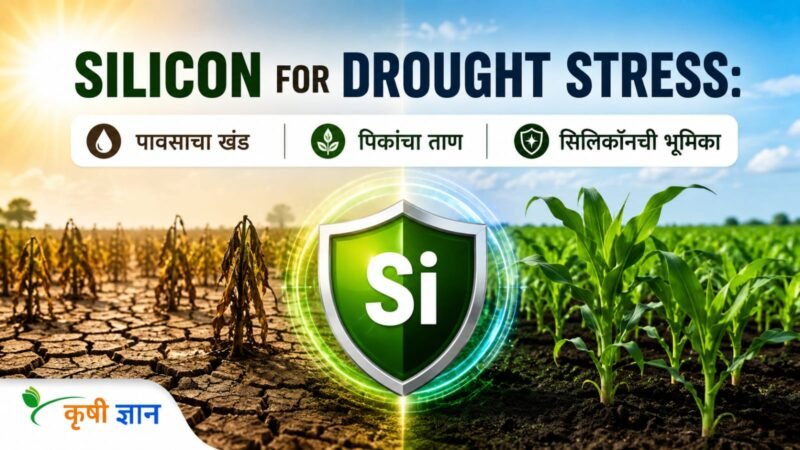
In drought-prone regions, a 40–45 day rainfall gap can severely reduce soil moisture and create crop water stress.
Gypsum cannot create water or keep the soil wet for 45 days by itself.
Its potential benefit is mainly related to the next rainfall event.
If soil structure and infiltration improve, more rainwater can enter the soil instead of flowing away as runoff.
The practical concept is:
Rainfall → Better infiltration → More root-zone water → Better availability of moisture to crops
This is why gypsum can be considered a soil-management tool for improving rainfall-use efficiency, rather than a direct drought-control product.
Major Agricultural Benefits of Gypsum
Depending on soil conditions, gypsum can provide several benefits:
– Supplies Calcium and Sulphur
– Helps improve soil structure in suitable soils
– Can improve water infiltration
– May reduce surface crusting and clay dispersion
– Helps reclaim sodic soils
– Supports better root-zone conditions
– Can improve the efficiency of rainfall and irrigation water
– Provides Sulphur where soil sulphur deficiency exists
Gypsum is particularly relevant when the soil has a sodium-related structural problem.
Can Gypsum Be Used Before Rabi Crops?
Yes. Gypsum can be used in the Rabi season when there is a genuine soil or nutrient requirement.
Before application, it is better to understand the soil condition through testing.
Important parameters include:
pH, EC, CEC, Exchangeable Calcium, Exchangeable Sodium, ESP/SAR, soil texture and organic carbon.
This is important because:
High soil pH does not automatically mean that gypsum is required.
Gypsum is especially useful when the problem involves sodicity, poor infiltration, calcium deficiency or sulphur deficiency.
For serious sodic-soil reclamation, the gypsum requirement should ideally be calculated from soil-test results rather than using the same dose for every field.
Does Gypsum Give Long-Term Benefits?
It can, but the duration and magnitude of the benefit depend on soil conditions.
Factors such as:
– Soil texture
– Sodium status
– Drainage
– Organic matter
– Rainfall
– Irrigation water quality
– Gypsum purity
– Application rate
– Soil management practices all influence the result.
In sodic soils, properly planned gypsum application combined with adequate water and drainage can provide longer-term improvement in soil physical conditions.
However, one gypsum application should not be considered permanent drought protection.
Gypsum Alone Is Not Enough for Drought Management
If the main objective is to keep soil moisture available for a longer period, gypsum should be part of an integrated soil-management strategy.
A better approach is:
Gypsum + Organic Matter + Crop Residue + Good Soil Structure + Deep Rooting + Moisture Conservation
Here, each component has a different role.
Gypsum: Calcium, Sulphur and improvement of soil structure/infiltration under suitable conditions.
Organic matter: Supports aggregation, biological activity and soil moisture retention.
Crop residues: Help protect the soil surface and reduce evaporation and runoff.
Deep and healthy roots: Allow crops to explore a larger volume of soil for available water.
Gypsum is not a direct water-storage chemical and should not be marketed as a drought cure.
Its real agricultural value is in supplying Calcium and Sulphur and, under suitable soil conditions, improving soil structure, infiltration and root-zone water availability.
For farmers facing long rainfall gaps such as 40–45 days, the objective should not be to use gypsum simply to “store water.” Instead, the objective should be to improve the soil so that more rainfall enters the root zone and remains available to the crop.
Therefore, before using gypsum in the Rabi season, soil testing and correct identification of the soil problem are important. Where sodicity, poor infiltration, calcium deficiency or sulphur deficiency is present, gypsum can become a useful component of long-term soil and drought-management practices.
Also Read this
Nematodes in Ginger: Symptoms, Types & Control Guide
https://krushigyan.com/nematodes-in-ginger-symptoms-types-control-guide/
Click the link below to join our Facebook group for the latest updates on modern agriculture.