Why Trichoderma Asperellum is Different From other Species
Use of Trichoderma Asperellum in Modern Agriculture
Introduction
The genus Trichoderma has become one of the most important biological tools in modern agriculture. These naturally occurring, beneficial soil fungi play a vital role in sustainable crop production by suppressing plant diseases, improving root development, enhancing nutrient availability, and increasing overall crop productivity.
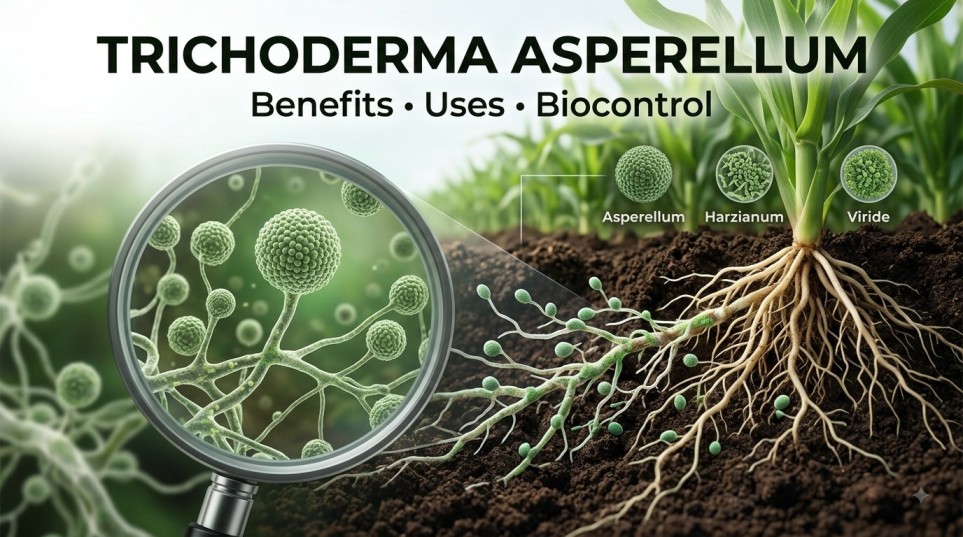
Among the commercially available species—Trichoderma viride, Trichoderma harzianum, and Trichoderma asperellum Trichoderma asperellum has emerged as the most advanced and efficient bio-control organism. Backed by extensive scientific research and successful field performance, it offers superior root colonization, broad-spectrum disease management, enhanced plant growth, and remarkable tolerance to environmental stresses.
Why Trichoderma asperellum is Different
Unlike conventional biological inoculants, T. asperellum rapidly establishes a dense and long-lasting protective zone around plant roots, commonly known as the rhizosphere. Once established, it actively protects roots throughout the crop cycle while continuously supporting plant growth.
Its major distinguishing features include:
– Rapid establishment around roots.
– Long-term persistence in the rhizosphere.
– Excellent adaptability to different soil types and climatic conditions.
– Consistent performance under varying pH, moisture, and temperature conditions.
Rapid Root Colonization
One of the greatest strengths of T. asperellum is its exceptional ability to colonize plant roots immediately after application.
It forms a dense biological coating over the root surface, creating a protective barrier that prevents harmful fungi from accessing root tissues. Faster colonization also allows beneficial microorganisms to dominate the rhizosphere before pathogens become established.
This early protection significantly reduces the chances of infection during the most vulnerable stages of crop growth.
Broad-Spectrum Disease Suppression
T. asperellum exhibits powerful antagonistic activity against a wide range of economically important soil-borne pathogens responsible for severe crop losses worldwide.
It effectively suppresses diseases caused by:
– Fusarium spp. – Wilt
– Rhizoctonia solani – Root Rot and Collar Rot
– Pythium spp. – Damping-Off
– Phytophthora spp. – Root, Stem and Fruit Rot
– Sclerotium rolfsii – Stem Rot
– Macrophomina phaseolina – Dry Root Rot
Its broad-spectrum activity makes it suitable for diverse cropping systems.
Six Powerful Modes of Action
Unlike chemical fungicides that usually rely on a single mechanism, Trichoderma asperellum attacks pathogens through multiple biological processes simultaneously, greatly reducing the possibility of resistance development.
1. Mycoparasitism
Directly attacks, penetrates, and destroys the hyphae of pathogenic fungi.
2. Competition for Space and Nutrients
Rapidly occupies the rhizosphere, leaving little space or nutrients available for pathogens.
3. Enzymatic Degradation
Produces powerful enzymes such as chitinases, β-glucanases, and proteases, which break down fungal cell walls.
4. Antibiosis
Secretes natural antifungal compounds that inhibit the growth and multiplication of harmful fungi.
5. Induced Plant Defense
Activates the plant’s natural immune system, preparing it for future pathogen attacks.
6. Rhizosphere Shielding
Forms a dense protective microbial layer over roots, physically preventing pathogen invasion.
Root Development and Plant Growth Promotion
Beyond disease control, T. asperellum functions as an effective plant growth-promoting fungus (PGPF).
It produces various bioactive metabolites that stimulate:
– Root elongation
– Lateral root branching
– Root hair development
– Greater root surface area
– Improved nutrient absorption
– Increased seedling vigor
– Enhanced canopy development
– Better overall crop establishment
Enhanced Nutrient Mobilization
Many essential nutrients remain locked in insoluble forms within the soil, limiting their availability to plants.
Trichoderma asperellum improves nutrient uptake by converting these unavailable nutrients into plant-accessible forms through the production of organic acids and other metabolites.
It enhances the availability of:
– Phosphorus (P)
– Iron (Fe)
– Zinc (Zn)
– Manganese (Mn)
This improved nutrient mobilization leads to healthier crops while increasing fertilizer-use efficiency.
Activation of Induced Systemic Resistance (ISR)
One of the unique features of T. asperellum is its ability to activate Induced Systemic Resistance (ISR).
Instead of directly fighting pathogens alone, it “trains” the plant’s immune system to respond more rapidly and effectively when diseases attack.
ISR activates important defense pathways, including:
– Jasmonic Acid pathway
– Ethylene signaling pathway
As a result, plants become naturally more resistant to several diseases throughout the growing season.
Improved Tolerance to Abiotic Stress
Modern agriculture frequently faces environmental challenges that reduce crop productivity.
Trichoderma asperellum helps plants tolerate several abiotic stresses, including:
– Drought and water scarcity
– High soil salinity
– Temperature fluctuations
– Heat stress
– Moisture stress
Its stress-mitigating effects help maintain plant growth even under unfavorable environmental conditions.
Long-Term Survival in the Rhizosphere
Unlike many biological inoculants that decline rapidly after application, T. asperellum survives for extended periods because it produces highly resilient survival structures known as chlamydospores.
These structures enable it to:
– Survive harsh environmental conditions.
– Maintain high population levels around roots.
– Provide prolonged disease protection.
– Reduce the frequency of repeated applications.
Performance Comparison Among Trichoderma Species
Trichoderma viride
– Basic disease suppression
– Moderate root colonization
– Moderate plant growth promotion
– Basic ISR activation
– Moderate nutrient mobilization
– Short-term persistence
Trichoderma harzianum
– Strong disease suppression
– Fast root colonization
– High plant growth promotion
– Moderate ISR activation
– Good nutrient mobilization
– Moderate persistence
Trichoderma asperellum
– Superior broad-spectrum disease control
– Rapid and dense root colonization
– Excellent root architecture development
– Advanced ISR activation
– Highly efficient phosphorus and micronutrient solubilization
– Outstanding environmental adaptability- Long-term rhizosphere persistence through abundant chlamydospore production
Suitable Crops
Due to its broad-spectrum activity, Trichoderma asperellum can be successfully used in numerous agricultural and horticultural crops.
Also read this
Sulphur in Agriculture: The Complete Guide for Rabi Crops
https://krushigyan.com/sulphur-in-agri-the-complete-guide-for-crops/
Click the link below to join our Facebook group for the latest updates on modern agriculture